Is There a $5 Overdraft Fee Cap? What Banks Can Charge Now
Last updated:
Written by
Reviewed by Rob Roderick
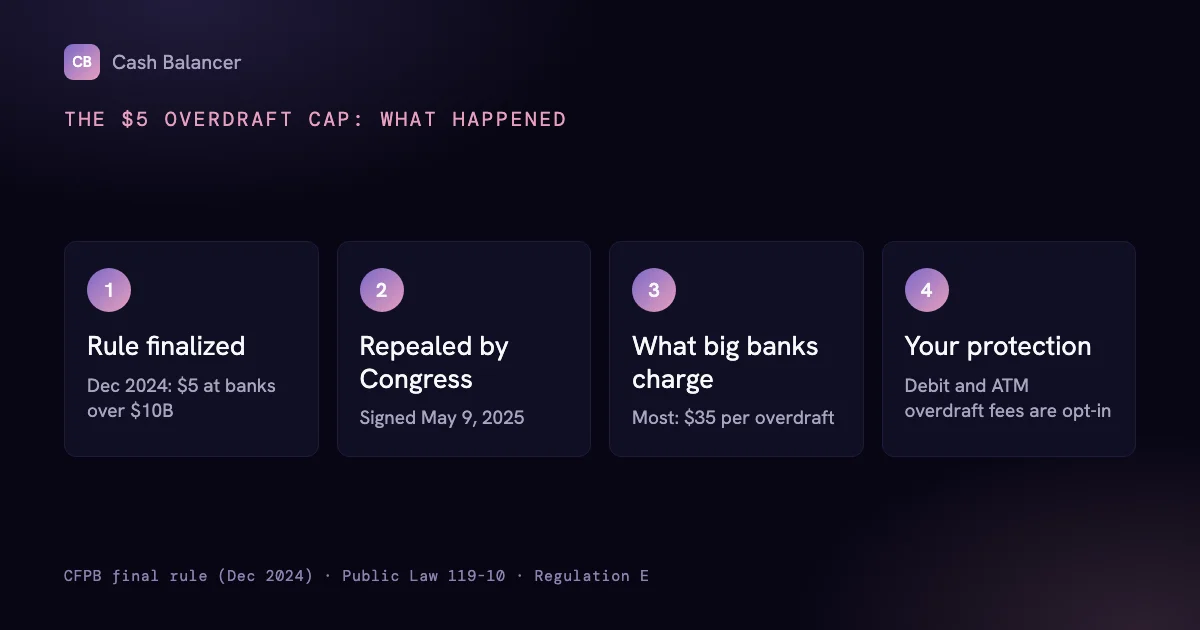
If you searched for the CFPB's $5 overdraft fee cap, here's the short answer: it never took effect. The Consumer Financial Protection Bureau finalized the rule in December 2024, Congress voted to overturn it before its start date, and the repeal was signed on May 9, 2025 (Public Law 119-10). The CFPB now says the rule "has no force or effect" (CFPB).
So there is no federal cap on overdraft fees. But you still have a real protection that most people don't use, and you can set your account up so you never pay one. Here's what changed, what banks charge now, and the steps that keep you out of the red.
What the $5 overdraft rule would have done
The rule covered only very large banks and credit unions, those with more than $10 billion in assets. It would have let them charge a $5 overdraft fee, charge more only if the fee just covered their costs, or treat overdraft as a loan with the same protections and disclosures as other credit. It was set to start on October 1, 2025 (CFPB final rule). Smaller banks and credit unions were never covered.
What happened to it
Congress passed a joint resolution, S.J. Res. 18, disapproving the rule. It was signed on May 9, 2025 and became Public Law 119-10, which says the rule "shall have no force or effect" (Public Law 119-10). The CFPB updated its rule page to match, and notes that the rest of its overdraft regulations are unchanged (CFPB).
That last part matters: the opt-in rule below was never part of the $5 cap, and it still protects you.
What banks charge for overdrafts now
When the CFPB finalized the rule in December 2024, it reported that 68% of banks and credit unions with more than $10 billion in assets charged $30 to $37 per overdraft, more than half charged exactly $35, and most let customers run up several overdraft fees in one day. The same institutions had mostly dropped NSF (non-sufficient funds) fees for declined payments (CFPB final rule).
Fees have come down from their peak. Banks that report overdraft and NSF revenue collected $5.83 billion in 2023, 51% less than the $11.96 billion they reported in 2019. The CFPB estimated that drop saves a household that overdrafts about $185 a year (CFPB).
Still, one overdraft can turn a small purchase into an expensive one. At $35, a $6 lunch costs $41. Two of those in one day is $70 in fees for $12 of food.
The protection you still have: overdraft is opt-in for debit cards and ATMs
A federal rule that has nothing to do with the repealed cap is still in force. Under Regulation E, your bank can't charge an overdraft fee on an ATM withdrawal or a one-time debit card purchase unless you agreed to overdraft coverage for those transactions, and you can take that consent back at any time (Regulation E §1005.17).
- If you haven't opted in, the bank can decline the purchase, or pay it without charging you an overdraft fee.
- You can opt out whenever you want, the same way you opted in, and the bank has to make the change as soon as reasonably practicable. It doesn't have to refund fees charged before that.
- Checks, automatic payments and recurring debit card payments aren't covered by the opt-in. Banks typically cover those by default, up to a limit, and can charge overdraft fees on them (CFPB final rule). That's why timing your bills matters.
How to never pay an overdraft fee
- Check your opt-in status. Look in your banking app's settings (often under overdraft or debit card settings), or call your bank. If you're opted in for debit card and ATM overdrafts, opt out. A purchase you can't cover gets declined instead of costing you $35.
- Turn on low-balance alerts. Many bank apps can notify you when your balance drops below a number you choose. Pick one that covers a few days of spending.
- Keep a buffer in checking. Leave enough to cover the bills due before your next paycheck, plus a cushion. How much money to keep in checking walks through the math.
- Line up your bills with payday. Many overdrafts are timing problems: a bill hits the day before your paycheck. Ask billers to move due dates to a few days after payday.
- Link a savings account. Many banks will move money from savings to cover a shortfall. Ask whether they charge for that transfer, and how much.
- Choose an account without overdraft fees. Some banks and app-based accounts don't charge them at all. Compare the options in our neobank rankings.
- If you already got hit, ask for a refund. Message or call your bank and ask them to reverse the fee, especially if it's your first in a while. Asking costs nothing.
See where your money goes before it runs short
Overdrafts often come from not seeing a tight week coming. Cash Balancer's free calculator reads a month of your bank and card statements and shows what came in, what went out and what was left, so fees and short weeks stand out. No account and no bank login needed. The free Cash Balancer app keeps your must-pay bills next to your income as it lands, so you know what's left before you spend.
The bottom line
There's no $5 federal overdraft cap: Congress repealed it in May 2025, before it took effect. Big banks commonly charge about $35 per overdraft. But you control the most common trigger. If you don't opt in, your bank can't charge an overdraft fee on debit card purchases or ATM withdrawals. Opt out, set alerts, keep a buffer, and overdraft fees stop being your problem.
For the full list of fees to watch for, read the hidden bank fees quietly draining your account, or browse more banking guides.
Sources
- Public Law 119-10 (S.J. Res. 18), approved May 9, 2025 (U.S. Government Publishing Office)
- Overdraft Lending: Very Large Financial Institutions (CFPB)
- Overdraft final rule, December 2024 (CFPB)
- Overdraft/NSF revenue in 2023 (CFPB data spotlight, April 2024)
- Regulation E §1005.17: requirements for overdraft services (CFPB)
Ready to take control of your money?
Cash Balancer is the free app that shows you your debt-free date, where your money goes, and what's left to crush debt each month — no bank connection required. Not ready to install? The free online debt calculator and Cash Flow Report need no account either.
Download for iOS — It's FreeTry the free debt calculator — no sign-upMore on Banking & Saving
All Banking & Saving guides →High-Yield Savings Accounts in 2027: The Complete Guide (And Why You Probably Need One)
8 min read
Best Neobanks for Young and Underbanked Users: Top 5 Ranked by Cash Balancer
9 min read
Digital Banks vs. Traditional Banks: Which Is Actually Better for Your Money?
9 min read
How Much Money Should You Keep in Your Checking Account? (The Real Answer for 2027)
10 min read