Social Security for Gen Z and Millennials: What You Actually Need to Know
Last updated:
Written by
Reviewed by Rob Roderick
"Social Security won't even exist by the time I retire." You've heard this. Maybe you've said it. And if you're in your 20s or 30s, you've probably absorbed the idea that Social Security is someone else's retirement program — something your grandparents rely on but that you should mentally write off.
The reality is more nuanced — and more important to understand than most young adults realize. Social Security is already deducting money from every paycheck you earn. It will likely be a meaningful source of retirement income even for Gen Z, albeit possibly in modified form. And making smart decisions about when to claim Social Security could be worth hundreds of thousands of dollars over your lifetime.
Here's what you actually need to know.
How Social Security Works: The Basics
Social Security is a federal insurance program that provides retirement income, disability benefits, and survivor benefits to eligible workers and their families. It's funded by payroll taxes — specifically the FICA (Federal Insurance Contributions Act) taxes you see deducted from every paycheck.
What you pay: 6.2% of your gross wages up to the annual wage base, which is $192,300 for 2027 (SSA) and rises each year with national average wages. Your employer pays another 6.2%, for a combined 12.4%. If you're self-employed, you pay the full 12.4% yourself (SSA), and you can deduct the employer-equivalent half when figuring your adjusted gross income (IRS).
How you earn benefits: Social Security tracks your earnings history in terms of "credits." You earn credits as you work, up to 4 a year; Social Security sets the amount of earnings needed for each credit and raises it every year. You need at least 40 credits (about 10 years of work) to qualify for retirement benefits (SSA). Your benefit is based on your 35 highest-earning years, indexed to the growth in average wages (SSA).
The formula: Social Security's formula is progressive. For people who turn 62 in 2027, the full-retirement-age benefit is 90% of the first $1,340 of average indexed monthly earnings, plus 32% of earnings from $1,340 to $8,077, plus 15% of anything above $8,077 (SSA). So it replaces a larger share of pay for lower earners, while still paying higher earners a bigger check in dollars.
The Solvency Question: Will It Be There?
This is the existential question for Gen Z and younger millennials. The honest answer is: Social Security will almost certainly exist in some form, but benefits may be reduced relative to what current retirees receive — unless Congress acts.
Here's the specific concern:
Social Security is funded on a pay-as-you-go basis: current workers' payroll taxes fund current retirees' benefits. The trust funds (the reserves built up during decades when contributions exceeded payouts) are running down. The 2026 Trustees Report projects that the retirement trust fund runs out of reserves in late 2032, and the retirement and disability funds combined in 2034 (SSA).
After that, incoming payroll taxes would still pay 78% of scheduled retirement benefits, or 83% using the two funds combined (SSA). Without a change in the law, that means across-the-board cuts of roughly 17–22%.
The key point: this is not a scenario where Social Security "goes away." It continues operating on payroll tax revenue. The question is whether benefits are at 100%, 80%, or some other percentage of what current law promises.
Congress has addressed Social Security funding crises before. In 1983 it passed a law that, among other changes, gradually raised the full retirement age from 65 to 67 (SSA). A similar fix is likely again, probably including some combination of:
- Further increasing the full retirement age
- Raising or eliminating the wage cap on payroll taxes
- Modestly reducing benefits for higher earners
- Adjusting the benefit formula
For planning purposes, a conservative approach is to count on about 78% of your projected benefit, which is what the Trustees project the retirement fund could pay from incoming taxes if Congress does nothing. That builds in a buffer without writing off a program that will very likely pay out something significant.
What Your Social Security Benefit Might Actually Be
The Social Security Administration offers a free my Social Security account where you can see your earnings history and estimated benefits at different claiming ages. It's worth checking in your 20s and 30s to make sure every year of your earnings was recorded correctly.
For a rough number without signing in, SSA's Quick Calculator estimates your benefit from your date of birth and current earnings.
Even reduced by 17–22%, your benefit is a meaningful income stream. For a couple where both partners worked throughout their careers, combined Social Security benefits can provide substantial retirement income.
When You Can Claim — and Why It Matters Enormously
Your "full retirement age" (FRA) for Social Security depends on your birth year. For everyone born 1960 or later (which includes most millennials and all of Gen Z), the full retirement age is 67 (SSA).
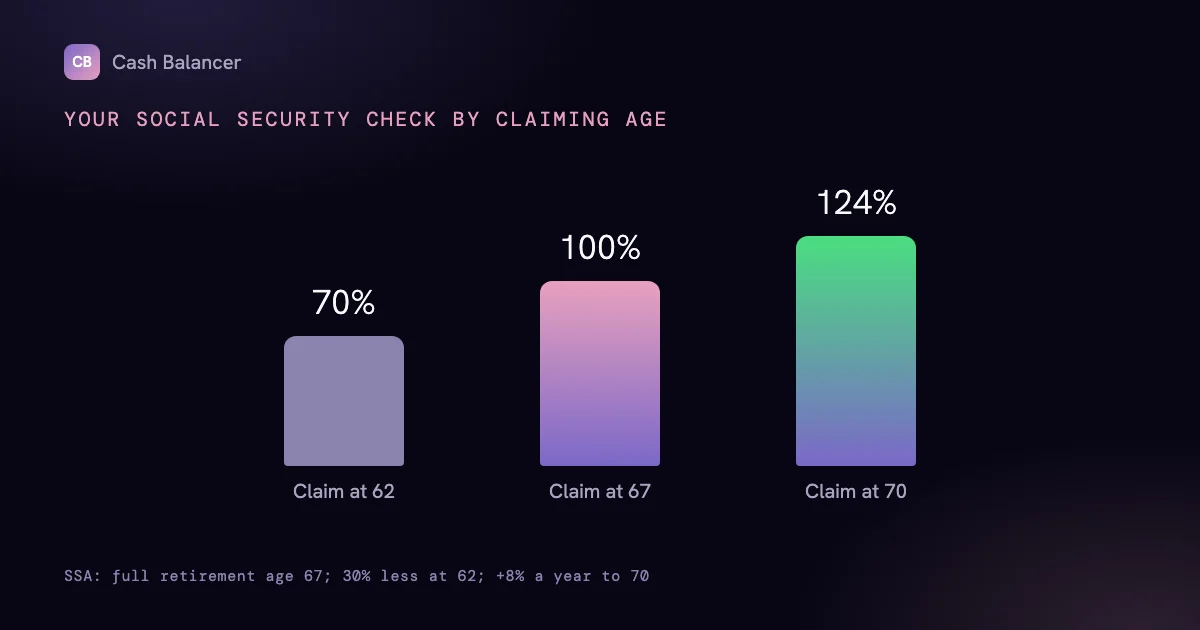
You can begin collecting Social Security as early as age 62 — but doing so permanently reduces your monthly benefit by 30% compared to waiting until 67 (SSA). On the other side, delaying beyond 67 increases your benefit by 8% per year up to age 70 (SSA), for a benefit that's 24% higher than the full retirement age benefit.
The math on claiming age is substantial. Compare a $2,000/month full retirement age benefit:
- Claim at 62: $1,400/month (reduced by 30%)
- Claim at 67: $2,000/month (full benefit)
- Claim at 70: $2,480/month (24% more from delayed credits)
The difference between claiming at 62 and claiming at 70 is $1,080/month — $12,960/year. Over a 20-year retirement, that's roughly $259,000 in additional lifetime benefits (before accounting for the years you'd have collected the smaller benefit from 62 to 70).
The break-even analysis: If you claim early at 62 vs. waiting until 67, you "break even" at roughly age 78–80 — meaning you collect the same total lifetime benefits at that age whether you claimed early or at 67. If you live past the break-even point, waiting pays off. If you live a shorter life, claiming early comes out ahead.
For people in good health with family longevity histories, waiting as long as possible (at least to FRA, ideally to 70) is typically the mathematically superior choice.
Social Security Strategies Worth Knowing
Married Couples Can Coordinate
Married couples have powerful claiming strategy options. A common approach:
- The lower earner claims earlier (at 62 or FRA) to provide income while the household waits
- The higher earner delays to age 70 to maximize the larger benefit
This can raise the household's lifetime benefits while providing some income during the gap years.
Divorced Spouses Have Rights
If you were married for at least 10 years, you may be eligible for benefits on your ex-spouse's work record (SSA), up to half of their benefit amount. Payments to ex-spouses don't count toward the family maximum, so they don't shrink what your ex's current family receives (SSA). This is worth knowing if you were in a long marriage where one partner earned significantly more.
Working While Collecting Has Implications
If you claim Social Security before your full retirement age while still working, Social Security withholds $1 of benefits for every $2 you earn above a yearly limit, which is $25,560 in 2027 (SSA). Earnings from the month you reach full retirement age on don't count, and once you reach FRA your monthly benefit is permanently increased to make up for the months that were withheld (SSA).
What Social Security Means for Your Retirement Plan Now
If you're in your 20s or 30s, Social Security is one component of a three-legged retirement stool: personal savings/investments, employer-sponsored retirement plans (401k, 403b), and Social Security. Ignoring it completely (as some financial advice encourages) leaves out a meaningful income stream.
How to factor it into planning now:
- Create your ssa.gov account and check your earnings record — Do this at least once every few years to catch any errors. Missing earnings credits can reduce your eventual benefit.
- Plan on about 78% of your projected benefit — Conservative, and in line with the Trustees' projection if Congress does nothing
- Build retirement savings as if Social Security doesn't exist — This may sound contradictory, but building your 401k and IRA contributions assuming zero Social Security means that if Social Security does pay out, it's a bonus that makes retirement even more comfortable. If you build your plan counting heavily on Social Security and it's reduced, you have a problem.
- Think about claiming age well before you're ready to retire — While there's no action to take now, understanding the trade-offs early means you'll make an informed decision when the time comes instead of defaulting to the earliest option
The Bottom Line
Social Security is not a mythical promise that will evaporate before Gen Z reaches retirement age. It's a real program you're already paying into with every paycheck, and it will likely provide meaningful retirement income. Even if Congress does nothing, incoming taxes would pay about 78–83% of scheduled benefits once the reserves run out, according to the 2026 Trustees Report (SSA).
Understanding how it works, what your projected benefit is, and how claiming age dramatically affects lifetime benefits puts you in a much stronger position to make smart retirement decisions. It's also a reminder that the payroll taxes coming out of your paycheck aren't just disappearing — they're building future income that, combined with your personal savings, forms the foundation of a financially secure retirement.
The most important thing you can do for retirement security right now isn't Social Security optimization — it's building your own savings through 401k contributions and IRA investing. Cash Balancer can help you track your budget and find room to increase your monthly contributions. Download Cash Balancer free on iOS.
Ready to take control of your money?
Cash Balancer is the free app that shows you your debt-free date, where your money goes, and what's left to crush debt each month — no bank connection required. Not ready to install? The free online debt calculator and Cash Flow Report need no account either.
Download for iOS — It's FreeTry the free debt calculator — no sign-upMore on Investing
All Investing guides →How to Start Investing for Beginners This Month (Not Someday)
10 min read
How to Build Wealth While Renting (You Don't Need to Own a Home)
9 min read
Coast FIRE: How to Stop Saving for Retirement Without Working Forever
10 min read
Crypto Investing for Young Adults: What You Need to Know Before Putting Money In
9 min read